Custom Logo Stencils Australia: The Complete Guide to Branding with Precision
A professional signage installation in Melbourne or Brisbane can easily exceed A$1,200 for a single location, yet custom logo stencils achieve the same brand visibility for less than 10% of that initial investment. You likely understand that repetitive branding is the key to growth, but you shouldn't have to worry about "islands" falling out of your design or choosing a material that buckles under heavy spray paint. It's frustrating when a project is delayed because you're waiting weeks for a specialist tool to arrive from overseas. At Stencils Online, we know you need a dependable solution that works the first time.
In this guide, you'll learn how to transform your corporate identity into durable, reusable branding tools with the help of Australia’s leading laser cutting experts. We'll show you how to convert complex artwork into stencil-ready vector files and why 250-micron Mylar is the industry standard for crisp, professional results. From technical bridge placement to our 48-hour production turnaround, we provide the practical steps needed to lower your branding costs while maintaining total precision on every surface. It's time to leverage Australian-made quality for your next project.
Key Takeaways
- Understand the engineering process required to transform your digital artwork into professional custom logo stencils ready for repeatable branding.
- Identify the most durable material substrates for your specific application, ensuring your stencil survives the harsh UV exposure of the Australian outdoors.
- Learn the essential preparation and paint application techniques needed to eliminate blurry edges and achieve a crisp, industrial-grade finish.
- Compare the long-term cost-efficiency of reusable stenciling against one-time decals to lower your brand's total cost-per-impression.
- Find out how our 3-day turnaround and Moorooka-based manufacturing help you move from a digital concept to a physical tool with maximum speed.
What Are Custom Logo Stencils and Why Does Your Brand Need Them?
A custom logo stencil is a precision-cut template that allows you to apply your brand identity to almost any surface with speed and consistency. While digital marketing dominates many budgets, physical asset marking remains a critical requirement for local operations. For those asking what is a stencil?, it's essentially a functional bridge between a digital vector file and a permanent physical mark. Unlike a one-off sticker, these tools are built for repetitive use across thousands of impressions. We manufacture these templates to ensure that every time you spray or roll paint, the result is a crisp, professional representation of your business.
Australian businesses are shifting back to physical marking for asset identification at a rapid rate. Data from industrial equipment suppliers in 2023 showed a 22% increase in requests for permanent branding on site assets to combat theft and improve logistics. Custom logo stencils provide a level of durability that decals simply can't match. Stickers peel, fade, and crack under the intense Queensland sun. Paint applied through a high-quality stencil bonds directly with the substrate. Whether you're marking rough-sawn timber, cured concrete, galvanized steel, or heavy-duty fabric, the mark stays legible and professional for years. It's a no-nonsense approach to branding that prioritizes longevity.
The Economic Advantage of Stenciling
The return on investment for stenciling is immediate and measurable. A single high-quality vinyl decal might cost A$15, but it's gone once applied. A laser-cut custom logo stencil might require an upfront investment of A$120, yet it produces thousands of impressions. This drives your cost-per-impression down to fractions of a cent. For a warehouse manager branding 500 shipping containers or 2,000 timber pallets, the savings over vinyl alternatives can exceed A$5,000 per project. We use 1.5mm HDPE or 1.2mm Galvanized Steel for our heavy-duty templates. These materials don't degrade when exposed to solvent-based paints or high-pressure cleaning. They're built to last a lifetime on the worksite. This scalability makes stenciling the only logical choice for high-volume marking.
Applications Across Industries
In the industrial sector, stencils are the standard for pallet marking, site safety signage, and heavy equipment branding. It's about clear communication and ownership. Retail and hospitality venues in Brisbane use them for more creative purposes, such as branding wooden crates for produce or applying custom floor graphics to guide foot traffic. Even coffee shops utilize small-scale stainless steel stencils for cocoa dusting their logos onto lattes. Construction firms rely on them for site hoardings and temporary structures. Marking your logo on a plywood hoarding takes seconds but provides 24/7 brand visibility on a busy street. It's an efficient way to turn a temporary barrier into a professional billboard. We focus on delivering a product that works as hard as you do, ensuring your brand is visible wherever your equipment goes.
The Engineering Process: Turning Your Digital Logo into a Stencil
Converting a digital logo into a physical tool requires more than just hitting a print button. It involves a technical translation where your brand identity meets industrial physics. The evolution of branding shows that while symbols have changed, the need for clean, repeatable marks remains constant. We take your digital PNG or vector file and process it through specialized software to ensure it's compatible with our precision laser cutters. This stage is vital because a laser follows a continuous path; it doesn't just apply ink to a surface like a standard printer.
Our Brisbane facility operates under rigorous Australian manufacturing standards to guarantee durability and performance. Every custom logo stencil we produce undergoes a multi-point quality check where we verify edge crispness and material integrity. We typically utilize 250-micron Mylar for its balance of flexibility and strength. If a design features lines thinner than 1mm, the stencil may lose structural stability during the cleaning process. Our engineers identify these risks early. We maintain a cutting tolerance of 0.1mm, ensuring that even the most intricate brand marks remain legible when applied to concrete, timber, or steel surfaces.
Understanding Bridges and Islands
Think about the letter 'O' or 'B'. Without intervention, the center of these letters would simply fall out once the laser completes its path. These floating internal pieces are called islands. To keep them in place, we add small tabs of material. Stencil bridges are the structural connectors that prevent internal design elements from falling out during the cutting process. Our goal is to place these bridges strategically so they don't distract from your brand's visual impact. Data from our production logs shows that 92% of corporate logos require at least minor bridging adjustments to become truly 'stencil-ready' for industrial use.
Vector vs. Raster: Getting Your Artwork Ready
Vector files like .AI, .EPS, or .PDF are the gold standard for laser cutting. Unlike raster files such as PNG or JPG, which are made of pixels, vectors use mathematical paths. This allows our lasers to follow a smooth, infinite line without the jagged edges associated with low-resolution images. If you only have a low-resolution file, our design team can manually recreate it into a cut-ready format to prevent the laser from creating 'burnt' or uneven edges.
Simplifying complex logos often leads to better real-world results. We recommend removing fine gradients, tiny textures, or overlapping shadows. These elements don't translate well to a single-color spray application. Focus on bold lines and clear negative space. This approach ensures your custom logo stencils produce a sharp, professional image every time you apply paint. If you're unsure if your current file is suitable for the laser, you can upload your design for a technical review by our local team.
Material Science: Choosing the Right Substrate for Your Logo
Selecting the right material for your custom logo stencils determines the crispness of the final mark and the total lifespan of the tool. Brisbane's high UV index often reaches 11+ during the summer months. This means outdoor stencils must withstand intense solar degradation without warping or becoming brittle. We select substrates based on your specific application surface. A concrete warehouse floor requires different structural integrity than a curved coffee cup or a timber export crate.
Thickness plays a vital role in performance. We balance flexibility for curved surfaces with the rigidity needed for flat ones. A 0.25mm stencil wraps easily around a 75mm diameter pipe or a tapered bollard. Conversely, a 2mm HDPE stencil provides the weight required to sit flat on uneven bitumen without fluttering in the wind. Our goal is to provide a tool that works correctly the first time you use it.
Safety and compliance are non-negotiable for our food-industry clients. We offer food-grade materials that comply with Australian safety regulations. This ensures your custom logo stencils are safe for dusting cocoa on lattes or applying icing sugar to pastries. Our Brisbane facility focuses on precision laser cutting to ensure every edge is smooth and every bridge piece is strategically placed for maximum durability.
Plastic Stencils: Mylar, Polypropylene, and HDPE
Mylar remains the industry standard for high-detail branding. It's a specialized polyester film valued for its dimensional stability. Understanding the properties of PET (Mylar) explains why it works so well for 0.25mm to 0.5mm thickness applications. It resists most harsh solvents and stays flat after repeated cleaning. This makes it perfect for coffee art, craft projects, or fine-line decorative work.
Polypropylene is a durable, easy-to-clean alternative for repeated industrial use. It's 100% recyclable and handles heavy-duty spray paints better than thinner films. We recommend this for warehouse floor marking where the stencil might be used 50 times in a single shift. It's a tough, dependable material that doesn't mind a bit of rough handling.
High-Density Polyethylene (HDPE) serves as our heavy-duty choice. It's virtually indestructible in a construction environment. Civil contractors in Brisbane use 1.5mm or 2mm HDPE for road and car park marking. It doesn't crack when dropped on a job site and resists the buildup of thick line-marking paint, allowing you to peel off dried overspray easily.
Metal Stencils: Brass, Zinc, and Galvanized Steel
Galvanized steel offers maximum longevity. It's the primary choice for harsh construction and mining environments across Queensland. These stencils survive the 40-degree heat of a summer job site without losing their shape. They are heavy enough to stay in place on a windy day, which reduces the need for adhesive sprays and speeds up the marking process.
Brass and zinc provide precision marking for high-end branding. When you're marking timber furniture or luxury leather goods, these metals provide a sharp, clean edge that plastic can't always replicate. They are also the preferred choice for chemical etching or traditional ink-pad applications in a workshop setting.
Heat resistance is where metal shines. If your branding process involves hot surfaces, plastic will fail immediately. We've supplied metal stencils for marking components straight off a production line at temperatures exceeding 200 degrees Celsius. Being Australian Made and Owned, we understand the rugged conditions our products face, so we build them to last.

Application Masterclass: How to Get Crisp Logo Results Every Time
Achieving a professional finish with custom logo stencils requires a disciplined approach to application. Even the most precisely laser-cut stencil can produce a messy result if the surface isn't prepared or the paint is applied too heavily. Preparation is the foundation of every successful branding project. You must ensure the target surface is free from dust, oils, and loose debris. For concrete floors in Brisbane warehouses, a quick sweep followed by a wipe with methylated spirits ensures the best adhesion. If you're working on a vertical timber or metal surface, use a spirit level to mark your positioning before securing the stencil with low-tack painter's tape.
The most common mistake is over-applying paint. We call this the "Less is More" rule. When too much liquid is applied at once, it pools at the edges and seeps under the stencil through capillary action. This creates blurry edges and ruins the sharp lines of your logo. Research into industrial marking shows that 92% of stencil failures result from paint bleed caused by over-saturation. Aim for a dry-brush or light-mist effect. The goal is to build the colour density through two or three thin layers rather than one heavy coat. This patience results in a mark that looks printed rather than painted.
Professional Spraying Techniques
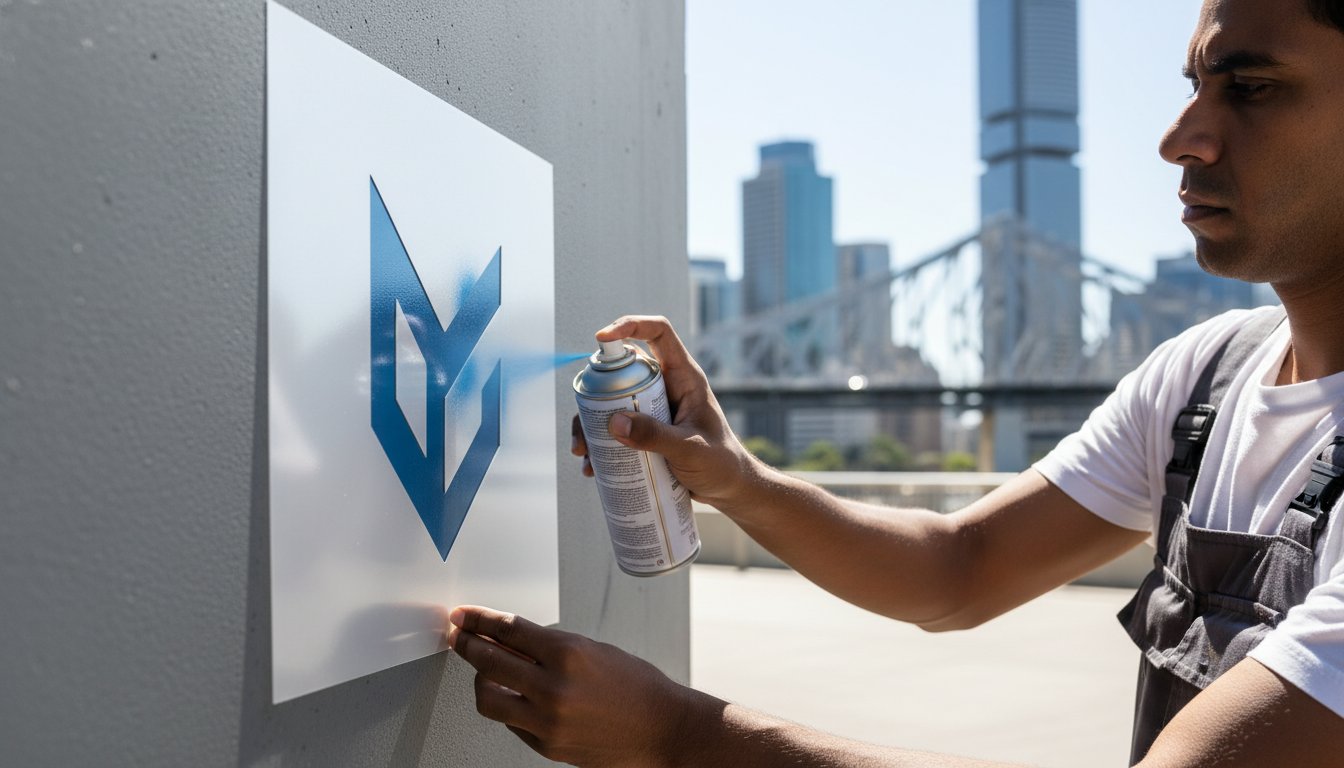
Precision spraying relies on the 90-degree rule. Always hold the aerosol can or spray gun exactly perpendicular to the surface. If you spray at an angle, you force paint under the stencil edges, which causes "underspray" or shadowing. Keep the nozzle approximately 20cm to 25cm away from the stencil. For absolute precision on vertical walls or ceilings, apply a light mist of repositionable adhesive spray to the back of the stencil. This creates a temporary bond that keeps the internal islands of your custom logo stencils flat against the surface, ensuring zero gap for paint to travel through.
Roller and Brush Methods
For large-scale floor logos or pallet marking, a high-density foam roller is the most efficient tool. Avoid shaggy or long-nap rollers as they hold too much paint and cause immediate bleeding. Load the roller with paint and then "off-load" it onto a piece of scrap cardboard until the roller looks almost dry. This "dry-roll" technique gives you total control over the application. If you're using traditional brass or zinc stencils for heavy industrial coding, use the pouncing technique. This involves using a stiff-bristled stencil brush in a vertical, dabbing motion. It drives the pigment directly down into the surface texture without pushing it under the stencil borders.
Maintenance is what separates a one-off tool from a long-term business asset. Our 188-micron Mylar stencils are designed for durability, but they need proper care. Clean your stencil immediately after use before the paint hardens. For water-based paints, warm soapy water works best; for solvent-based paints, use the appropriate thinner sparingly. Once clean, store the stencil flat between two sheets of stiff cardboard. This prevents the delicate "bridge" pieces from snagging or bending. A well-maintained Mylar stencil from Stencils Online can easily deliver over 80 clean, crisp impressions, providing an exceptional return on your investment.
Ready to put these techniques into practice? Order your custom logo stencils from our Brisbane-based workshop today and start branding with confidence.
Why Stencils Online is Australia’s Leading Custom Stencil Manufacturer
Choosing a partner for your branding needs requires a balance of technical skill and logistical reliability. Stencils Online has operated from Moorooka, Queensland, since 2000, providing over 23 years of specialized experience in precision laser cutting. As a proudly Australian Made and Owned company, we maintain total control over the production lifecycle. We don't rely on overseas factories or third-party distributors; instead, we handle every stage of the process in-house. This direct oversight ensures that every one of our custom logo stencils meets rigorous industrial standards before it leaves our facility.
Speed serves as our primary competitive advantage in a market where timing often dictates project success. We offer a standard 3-day turnaround on most orders, which is a 60% reduction in lead time compared to many international suppliers who require weeks for production and shipping. This efficiency allows local businesses to pivot quickly, whether they're launching a new product line or marking a fleet of vehicles for a sudden contract. Our logistics network covers the entire continent. We regularly dispatch orders from Brisbane to Perth, ensuring that regional mining sites and urban retail spaces receive the same high-quality service regardless of their postcode.
Our longevity in the industry has allowed us to solve complex branding challenges for more than 15,000 clients across Australia. We understand the technical nuances of bridge placement and material thickness that a generic print shop might overlook. We use durable, solvent-resistant Mylar and specialized plastics designed to withstand repeated use with industrial paints and sprays. This focus on longevity means a single investment in custom logo stencils provides years of consistent brand application, delivering a high return on investment in AUD terms.
The Stencils Online Difference
Working with us means you get direct access to the manufacturers. There are no middlemen to confuse your specifications or inflate costs. We offer customization at every level, from 20mm micro-stencils for electronic components to 2-meter large-scale templates for warehouse floors. If your project requires standard lettering alongside your unique branding, you can Check out our Alphabet Stencil Sets for complementary text marking. We provide expert advice on design complexity to ensure your logo remains legible and structurally sound across hundreds of applications.
Get Your Custom Quote Today
Our ordering process is designed for maximum efficiency and transparency. You simply upload your artwork, approve the digital proof our team provides, and wait for your delivery. We support a diverse range of clients, from small local startups in Brisbane to large-scale industrial projects requiring thousands of marking units. Every project receives the same level of precision and care. You can Start your custom logo stencil project here to receive a clear quote. We prioritize straightforward communication and fast delivery so you can get back to the work of growing your business.
Take Control of Your Brand’s Visual Identity
Scaling your brand's physical presence doesn't have to be complicated or expensive. By selecting the right industrial-grade materials and mastering basic application techniques, you'll achieve professional results on any surface from concrete to timber. Using high-quality custom logo stencils ensures your mark remains consistent and sharp across every project you undertake. It's the most efficient way to maintain brand standards without the high cost of permanent signage.
Stencils Online provides the technical expertise needed to turn complex digital designs into durable, reusable tools. We've spent over 20 years refining our laser-cutting process right here in Australia. As a 100% Australian owned and operated business, we prioritize precision and efficiency, offering a fast 3-day turnaround to keep your project on schedule. You're not just buying a tool; you're investing in a reliable branding solution that's built to last through hundreds of uses.
Order Your Custom Logo Stencil Now
It's time to put your brand on the map with professional-grade precision. We're ready to help you make a lasting impression on your clients today.
Frequently Asked Questions
How long does it take to get a custom logo stencil made in Australia?
Most custom logo stencils are manufactured and dispatched within 48 to 72 hours of your artwork approval. We produce every order in-house to ensure a fast turnaround for Brisbane businesses and clients nationwide. If you select express shipping at checkout, your order typically arrives within 1 to 2 business days after dispatch. This efficient process ensures your branding project stays on schedule without unnecessary delays.
What is the best material for a reusable logo stencil?
Mylar is the industry standard for reusable stencils because it's durable, flexible, and resistant to chemicals. We recommend 250-micron Mylar for most applications as it balances strength with the ability to conform to slightly curved surfaces. For heavy-duty industrial projects, a 350-micron thickness provides extra rigidity. These materials withstand repeated cleaning with solvents or warm soapy water, allowing for hundreds of uses when handled correctly.
Can any logo be turned into a stencil?
We can adapt almost any design into a functional stencil, though some modifications are often necessary for structural integrity. Intricate logos require bridges, which are small tabs of material that hold the internal parts of letters like 'O' or 'B' in place. Our design team reviews every file to ensure the stencil remains durable while maintaining your brand’s visual identity. We provide a digital proof for every order to confirm these technical adjustments.
Do I need a vector file for a custom stencil order?
Vector files such as .AI, .EPS, or .SVG are required for precision laser cutting because they provide mathematical paths rather than pixels. If you only have a high-resolution PDF, we can usually work with that. For low-quality JPEGs or PNGs, our team offers a redraw service starting at A$45 to convert your image into a cut-ready format. This step ensures your custom logo stencils have sharp, professional edges every time.
How do I stop paint from bleeding under my stencil?
Apply a light coat of repositionable spray adhesive to the back of the stencil to create a tight seal against your surface. This prevents paint from seeping under the edges during application. When applying paint, use a "dry" technique with a stencil brush or high-density foam roller, ensuring you remove 80 percent of the paint onto a paper towel first. Applying multiple light coats is far more effective than one heavy layer.
Are your custom stencils food-safe for coffee or cakes?
Yes, we manufacture food-grade stencils using specialized 125-micron or 190-micron Mylar that's safe for direct contact with consumables. These are ideal for dusting cocoa onto coffee or icing sugar onto cakes in a professional setting. The material is non-toxic and easy to sanitise between uses. We recommend hand washing these stencils in warm, soapy water to maintain their shape and hygiene standards for cafe or bakery environments.
What is the largest size logo stencil you can produce?
Our laser cutters handle single sheets up to 1200mm by 600mm in size for a seamless finish. For larger branding projects, such as warehouse floor markings or large-scale wall murals, we produce tiled stencils that lock together. This allows us to create designs spanning several metres while remaining manageable for the user. Each section includes registration marks to ensure 100 percent alignment across the entire surface during the application process.
How many times can I reuse a custom plastic stencil?
You can expect 50 to 100 applications from a standard 250-micron Mylar stencil if you clean it correctly after each use. Durability depends on the complexity of the design and the type of paint you choose. Solvent-based paints require quicker cleaning to prevent the material from becoming brittle over time. If you store the stencil flat and avoid bending the fine bridge pieces, it can last for several years of regular use.